
If you’ve spent any time managing digital infrastructure or building data pipelines over the last few years, you’ve likely hit the dreaded “batch processing wall.” You design a pristine system, only to watch it grind to a halt under the weight of scheduled late-night syncs, ballooning cloud bills, and frustrated business units waiting on stale, day-old reports.
In an era where operational efficiency dictates survival, waiting until tomorrow to analyze today’s data is a competitive death sentence.
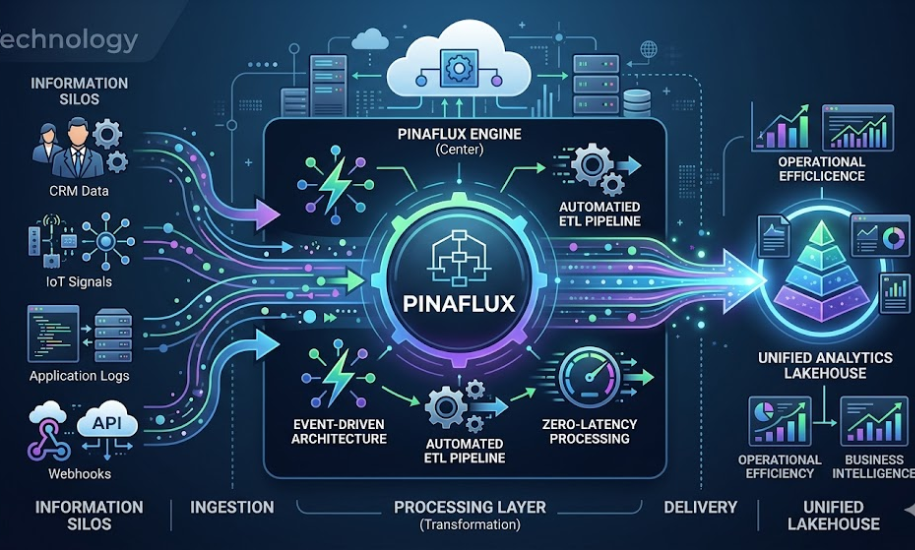
Enter the conversation surrounding modern real-time data streaming engines—and specifically, the emerging architectural paradigm known as Pinaflux. While traditional systems stall out on rigid batch windows and isolated information silos, forward-thinking infrastructure teams are shifting toward zero-latency, event-driven streaming solutions.
Before diving into the technical mechanics, schema structures, and deployment steps, let’s establish a quick baseline of this real-time framework:
| Metric / Aspect | Framework Specification |
| Core Architecture | Event-driven, continuous stream ingestion framework |
| Primary Use Case | Breaking down information silos; real-time automated ETL |
| Target Audience | Enterprise Data Architects, DevOps, CTOs, Tech Leads |
| Primary Competitors | Apache Kafka, AWS Kinesis, Snowflake Ingest Pipes |
| Key Advantage | Zero-latency streaming without uncapped compute cost penalties |
Core Architecture: How Pinaflux Handles Real-Time Data Integration
At its core, the framework is designed to solve a single, massive pain point: the latency and structural rigidity found in legacy enterprise data pipelines.
Traditional infrastructures rely heavily on scheduled, point-to-point connections. Your CRM syncs every six hours, your production databases dump logs at midnight, and your marketing webhooks fire into a completely separate repository. This fractured layout creates deep information silos, where no single system holds the absolute, real-time truth.
The architecture fundamentally flips this script by treating all incoming infrastructure activity as a continuous, unified stream of events rather than isolated files.
Continuous Stream Ingestion vs. Traditional Batch Processing
Batch processing treats data like cargo trains—waiting for the station to fill up completely before sending the shipment down the track. If a critical consumer trend occurs at 8:01 AM, your systems won’t register it until the next scheduled batch run, which might be hours away.
Continuous stream ingestion, on the other hand, operates like a fluid pipeline. Every individual transaction, user tap, or API ping is immediately captured as an atomic event. The engine registers the event, validates it against a central schema registry, and passes it down the line in milliseconds. By moving away from massive compute spikes to a flattened, steady processing curve, systems avoid the resource throttling that typically bogs down legacy relational database warehouses.
Automated Schema Evolution and Transformation (ETL)
One of the greatest silent killers of data pipeline health is “schema drift.” A third-party software provider updates an API, alters a variable from an integer to a string, and suddenly your entire automated ETL pipeline crashes, triggering a wave of high-severity alerts for your DevOps team.
Modern streaming logic bypasses this vulnerability through native, automated schema evolution. As raw events stream into the ingestion layer, the transformation engine handles data cleaning, type casting, and filtering in-flight. It dynamically adjusts to upstream changes without halting the entire pipeline, ensuring that downstream analytics layers receive clean, structured information without manual human-in-the-loop engineering interventions.
Pinaflux vs. Traditional Data Solutions: The Technical Contrast Matrix
To truly appreciate where a modern framework like this shines, we have to look past high-level marketing buzzwords and analyze how it stacks up against standard market implementations, such as Apache Kafka clusters or traditional cloud data warehouses (EDWs).
| Feature / Metric | Pinaflux Framework | Apache Kafka / AWS Kinesis | Legacy EDW Pipelines |
| Ingestion Type | Continuous Event-Driven | Low-Latency Log Streaming | Scheduled Batch Windows (T+1) |
| Setup Complexity | Low (Out-of-the-box UI/CLI) | High (Requires Complex Clustering) | Medium (Dependent on Manual Scripts) |
| Infrastructure Layout | Cloud-Native Autoscaling | Heavy, Fixed Broker Management | Rigid, Fixed Compute Units |
| Data Transformation | In-flight Automated Parsing | External Application Required | Post-Ingestion (Heavy DB Load) |
| Pricing Predictability | Consumption/Subscription Basis | High Network/Broker Overhead | Uncapped Processing Penalties |
The Real Cost of “Accidental Complexity”
Many enterprises default to Apache Kafka because it is a historic industry standard. However, Kafka requires massive operational overhead—managing brokers, tuning cluster coordination, and writing custom applications just to transform data inside the stream.
For teams that don’t have a dedicated army of platform engineers, this creates “accidental complexity.” A streamlined framework consolidates the ingestion, basic transformation, and delivery layers into a single, cohesive ecosystem, allowing small engineering teams to punch wildly above their weight class.
The Step-by-Step Blueprint of a Real-Time Data Pipeline
Without relying on complex code syntax, we can understand the workflow of a modern data pipeline by looking at its explicit operational sequence. When data moves through a real-time streaming engine, it undergoes a rapid four-stage lifecycle:
- The Ingestion Gateway: The engine establishes an open endpoint (like a secure webhook) that continuously listens for incoming global events, such as customer checkouts, app logins, or inventory updates.
- In-Flight Sanitization: Before the data is even stored, the transformation engine strips out or encrypts sensitive customer information, ensuring strict compliance with global privacy standards.
- Variable Validation: The pipeline instantly checks the incoming data to ensure numbers, timestamps, and letters are perfectly formatted, filtering out broken or corrupted requests automatically.
- Target Flushing: Every two seconds, the organized, highly polished data blocks are cleanly pushed into a central analytics database, making them instantly accessible to business teams.
Critical Business Impact: Scaling Efficiency Without Ballooning Costs
Building an efficient data pipeline isn’t just an intellectual exercise for software architects—it has immediate, sweeping consequences for a business’s bottom line. When data remains trapped in legacy setups, operational efficiency plummets across the entire corporate structure.
Eliminating Data Silos in E-Commerce and FinTech Ecosystems
Consider a modern e-commerce storefront. If your inventory management database only updates in a nightly batch run, but your front-end web application is aggressively running promotions on a viral product, you run the immediate risk of overselling stock. This leads to backorders, customer support logjams, and eroded brand trust.
By bridging infrastructure gaps with an event-driven framework, your front-end store, fulfillment centers, and marketing engines converse in real time. The moment a product sells out, your advertising spend can automatically pivot to a different item, preserving precious ad capital and optimizing profit margins instantly.
Predictable Subscription Pricing vs. Uncapped Processing Penalties
Traditional cloud data structures often penalize businesses for scaling. The more complex your data transforms become, the more compute power you consume during peak processing hours, leading to eye-watering bills at the end of the month.
By offloading the heavy lifting of data sanitization to an in-flight processing stream, you smooth out your infrastructure demands. Instead of massive, unpredictable compute spikes that trigger auto-scaling budget overages, your data costs scale linearly and predictably, tied directly to your actual data consumption rather than inefficient database indexing.
Frequently Asked Questions About Pinaflux
Is Pinaflux a replacement for existing cloud data warehouses like Snowflake or BigQuery?
No. It does not replace heavy analytical storage layers or long-term data lakes. Instead, it acts as the high-speed ingest and intelligent transformation layer that sits in front of them. It processes, filters, and formats real-time data streams before archiving them inside your data warehouse, reducing processing costs and keeping your main storage clean.
How does an event-driven architecture solve data integration silos?
Legacy enterprise frameworks isolate transactional databases, client-facing software, and internal CRMs into siloed, disparate environments. An event-driven engine breaks down these barriers by continuously listening to webhooks and native APIs from all systems simultaneously, broadcasting updates across the entire corporate ecosystem the exact millisecond they occur.
What happens if the network connection drops during a stream?
The framework utilizes local buffer storage and a resilient acknowledgment protocol. If a downstream destination goes offline, the streaming engine safely pauses the pipeline and caches incoming events locally. Once the destination connection is restored, the system seamlessly plays back the cached queue without losing a single data point.
Conclusion
The days of relying on sluggish, siloed batch processing are firmly behind us. As organizations scramble to implement real-time analytics, predictive machine learning models, and automated operational structures, the underlying architecture you choose will make or break your velocity.
Transitioning toward an event-driven streaming ecosystem allows you to eliminate expensive cloud compute spikes, break down legacy operational silos, and build a truly reactive tech stack. Here at Digi Journals, we love tracking the technical evolutions shaping the future of digital infrastructure. If you’re ready to maximize your operational efficiency and supercharge your business metrics, it’s time to audit your current pipeline and see where real-time streaming logic can streamline your operations.
What does your current data pipeline look like? Let’s chat in the comments section below—and don’t forget to subscribe to Digi Journals for more cutting-edge technical insights.
