
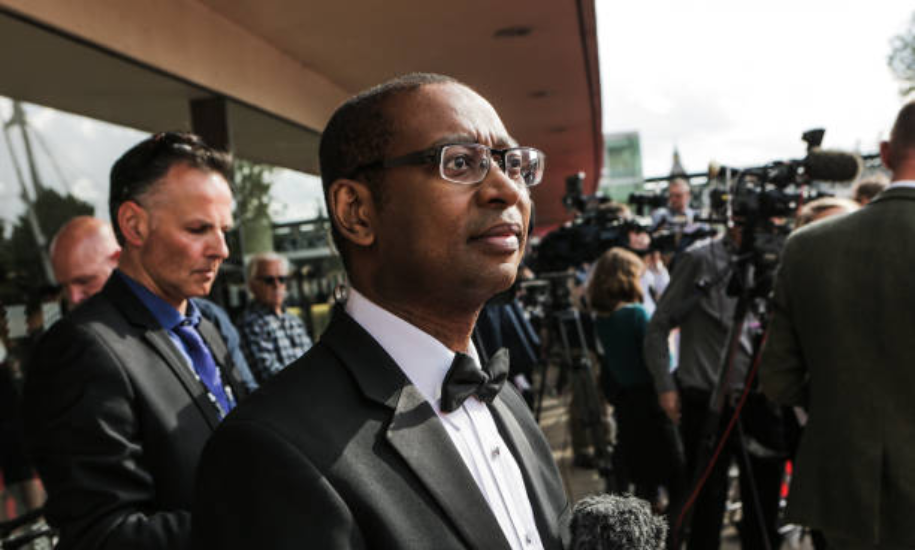
Lizo Mzimba is a name that has resonated in British living rooms for well over two decades. Whether it was explaining world events to a generation of young viewers on CBBC’s Newsround or reporting live from the red carpet at the Oscars and BAFTA Awards for BBC News, Mzimba has always carried a quiet authority that sets him apart. He is not loud. He is not controversial. He is simply consistent, credible, and compelling — qualities that have made him one of the most enduring figures in British broadcast journalism. Yet, for all his visibility on screen, Mzimba is a deeply private man. His family, his roots, his heritage — these are aspects of his life he guards carefully. This article takes a closer look at who Lizo Mzimba really is: where he comes from, what his background means to him, and how his identity has quietly shaped one of the finest careers in British media.
Quick Bio: Lizo Mzimba at a Glance
| Detail | Information |
|---|---|
| Full Name | Lizo Mzimba |
| Date of Birth | 6 December 1968 |
| Place of Birth | Solihull, Warwickshire, England |
| Nationality | British |
| Ethnicity | Black British (South African descent) |
| Parents’ Origin | South Africa |
| Surname Meaning | “Body” / “Flesh” (Chewa language, Southern Africa) |
| Siblings | Elder brother: Zola Mzimba |
| Education | Solihull School; University of Birmingham (Medicine & Law) |
| Career Start | 1991 (Sounds magazine) |
| BBC Start | 1994 (BBC Journalism Training Scheme) |
| Known For | BBC Newsround (1998–2008); BBC News Entertainment Correspondent (2008–present) |
| Social Media | Active on X (Twitter); no prominent public Instagram |
| Marital Status | Not publicly confirmed |
| Net Worth (est.) | $1 Million – $5 Million (approx.) |
Early Life and Background
Lizo Mzimba came into the world on the 6th of December, 1968, in Solihull — a prosperous town in the West Midlands county of Warwickshire, England. Solihull sits on the southern edge of Birmingham, and it was in this corner of middle England that Mzimba spent his formative years. He was born into a family that, while private by nature, was clearly rich in values and in culture. His upbringing in Solihull during the 1970s and 1980s was not without its challenges — this was an era in Britain when racial representation was scarce, particularly in media, and navigating life as a young Black boy in a predominantly white setting required resilience and a strong sense of self. That sense of self, one can argue, was partly provided by the strength of his family’s African roots.
From a young age, Mzimba demonstrated intellectual curiosity and a flair for leadership. He attended Solihull School, one of the West Midlands’ most respected independent schools, where he not only excelled academically but also served as leader of the Birmingham Schools’ Symphony Orchestra — an early signal of the poise and presence he would later bring to television screens across the country. After Solihull School, he pursued higher education at the University of Birmingham, where he enrolled in Medicine and Law — not the most obvious pathway to entertainment journalism, but one that equipped him with a rigorous, analytical mind. While at Birmingham, he discovered his true calling through the university’s student television station, where he threw himself into productions that went on to win awards at the National Student Television Association (NaSTA).
Lizo Mzimba’s Ethnicity
Lizo Mzimba identifies as Black British — a term that, for him, carries real cultural and personal weight. It is not merely a demographic label but a reflection of a life lived at the intersection of two worlds: the African heritage of his parents and the British society in which he was born and raised. His ethnicity is rooted in Southern African ancestry, specifically South African descent, which places him within one of the most culturally diverse and historically layered parts of the African continent.
Growing up Black in Britain during the 1970s and 1980s meant encountering a society still wrestling with questions of race, identity, and representation. Mzimba absorbed those experiences without letting them define him negatively. Instead, his dual identity — African in heritage, British in nationality — appears to have given him a broadened perspective that has translated well on screen. He has an instinctive ability to connect with people across cultural boundaries, to tell stories with empathy and context, and to represent audiences who rarely saw themselves reflected in mainstream media.
Lizo Mzimba’s Parents: Origins and Nationality
Perhaps the single most searched question about Lizo Mzimba concerns his parents — and understandably so, because they are the key to understanding the man himself. What is known, confirmed by multiple biographical sources, is that both of Lizo Mzimba’s parents were born in South Africa. They subsequently emigrated to the United Kingdom, and it was in England that Lizo and his elder brother Zola were born and raised.
The parents are, by all accounts, intensely private individuals. Their names have never been made public, and Lizo himself has consistently chosen not to discuss them in detail. This is not unusual — many public figures draw a firm line between their professional lives and their family’s privacy — but it does mean that much of what we know about his parents comes from indirect biographical evidence rather than his own words.
What we do know paints a meaningful picture. His parents were South African nationals who made the decision to start a new life in Britain, settling in Solihull and raising their children with a clear emphasis on education and cultural connection. They were evidently a family that cared deeply about staying tied to their African roots while adapting to life in the UK — a balance that many immigrant families strive for but not all achieve.
Lizo Mzimba’s Father: A Formative Journey
While Lizo Mzimba’s father has never been named publicly, one biographical episode stands out as a rare window into their relationship. In the summer of 1976, when Lizo was just seven years old, his father took him and his elder brother Zola on a five-week family holiday to South Africa. The trip was far more than a holiday — it was an act of cultural rootedness, a deliberate effort by a father to show his British-born sons where they truly came from.
The family stayed with relatives on a farm near Soweto, on the outskirts of Johannesburg. Young Lizo formed warm, innocent memories of farm life — the kind of simple, earthy experiences that stay with a person forever. He is said to have befriended a lamb during his stay, only to refuse to eat it upon learning its fate — a charming detail that reveals a sensitive, thoughtful child.
But the visit was also marked by historical gravity. It coincided with the Soweto Uprising of June 1976 — one of the most significant moments of resistance against apartheid in South African history. While his father was briefly away on a business errand, Lizo and Zola witnessed armored military vehicles rolling through the streets. For a seven-year-old British boy, it was a startling, indelible encounter with political reality. The experience almost certainly planted seeds of curiosity about the world, about injustice, and about the importance of bearing witness — seeds that would eventually grow into a career in journalism.
Lizo Mzimba’s Heritage and the Meaning of His Name
Heritage is not just about geography or genealogy. It lives in language, in surname, in the stories passed down. The name Mzimba is a case in point. In the Chewa language — a Bantu language spoken widely across Malawi, Zambia, and parts of Mozambique — the word mzimba means “body” or “flesh.” There is also a district in northern Malawi named Mzimba, underlining that the name carries deep geographical and cultural roots across Southern Africa.
This linguistic heritage places the Mzimba family within the broader Bantu cultural tradition, a civilization that spread across Central and Southern Africa through migrations between the 10th and 14th centuries. These migrations shaped the languages, kingdoms, agricultural practices, and identities of dozens of nations — including South Africa. So while Lizo’s parents are specifically of South African origin, the name Mzimba ties him to a vast, interconnected Southern African heritage that stretches across borders.
Lizo Mzimba has spoken openly about taking pride in his African background. He has embraced rather than shied away from that identity, and has been involved in various projects in the UK that celebrate diversity and inclusion — work that reflects a man who understands representation matters.
Lizo Mzimba’s Family: Brother Zola and Personal Life
Beyond his parents, the one confirmed family member in the public record is his elder brother, Zola Mzimba, who accompanied him on that 1976 trip to South Africa. Zola does not maintain a public presence, and very little is known about him beyond this mention. The Mzimba family as a whole appears to share Lizo’s instinct for privacy — a trait that, in an age of social media oversharing, is quietly admirable.
As for Lizo’s own romantic life, he has kept that equally guarded. No confirmed partner or spouse has ever been publicly identified. Reports suggest he may be single, though this has never been formally confirmed or denied. His parents similarly stay away from public appearances alongside him, meaning that for fans who follow him closely, even small biographical details feel significant
Lizo Mzimba on Instagram and Social Media
In an era where social media presence is practically mandatory for public figures, Lizo Mzimba takes a measured approach. He is active on X (formerly Twitter), where he occasionally shares professional updates and personal reactions to cultural moments. One memorable example came in April 2023, when British musician Jai Paul used Mzimba’s image as part of the visuals during his headline-making debut live performance at Coachella — a moment that went viral. Mzimba responded on X with warmth and gratitude, calling it an honor.
However, a widely searchable and active Instagram account for Lizo Mzimba does not appear to exist in the public domain. This is consistent with his overall approach to personal visibility — present when the work demands it, private otherwise.
Career Milestones
Lizo Mzimba’s professional journey is remarkable for its range and longevity. By 1991, fresh from university, he was writing for Sounds, the influential British music and entertainment magazine. He contributed to publications including The Guardian, The Sunday Express, and The Independent, building a strong editorial foundation before moving into broadcasting.
In 1994, he joined the BBC through its competitive journalism training scheme. Four years later, in 1998, he became a presenter on CBBC’s Newsround, the beloved children’s news programme — and he remained there for a full decade, making him the second longest-serving presenter in the programme’s history, behind only John Craven. His ability to explain complex world events to young audiences with clarity and calm was a rare and valued skill.
In 2003, he hosted a televised conversation with J.K. Rowling and screenwriter Steve Kloves about Harry Potter and the Chamber of Secrets — cementing his reputation as the BBC’s foremost authority on children’s literature and popular culture. He later produced a BBC1 documentary on Rowling and served as a children’s book judge for the prestigious Whitbread Children’s Book of the Year award.
His transition to BBC News Entertainment Correspondent in 2008 marked a new chapter. Since then, he has covered the Oscars, BAFTA Awards, Cannes Film Festival, and countless other major cultural events. He has appeared on BBC Breakfast, the BBC News Channel, and across multiple BBC platforms. He has also appeared as himself on The Sarah Jane Adventures, the beloved Doctor Who spin-off, and produced the 2023 BBC One documentary Phillip Schofield: The Interview. His awards include the Royal Television Society Award for Young Journalist of the Year and the Broadcast Award for Best Children’s Program.
A Quiet Legacy in British Media
What makes Lizo Mzimba truly significant is not just his longevity, but what he represents. He arrived in children’s broadcasting at a time when Black journalists on British television were a rarity. He built a career not through controversy or celebrity, but through craft — through the disciplined, thoughtful work of a man who takes journalism seriously. His South African roots, his British upbringing, his pride in a heritage encoded into his very name — all of it has quietly informed the journalist he has become.
For more profiles on journalists, media personalities, and cultural figures from around the world, visit Digi Journals — your trusted destination for well-researched, readable content about the people who shape our world.
You May Also Read:Gareth Barlow: From Sheep Farmer to Respected Sky News Journalist
